Category: ML & AI

  • The Finternet & Agentic AI: Building the “Self-Driving” Financial System

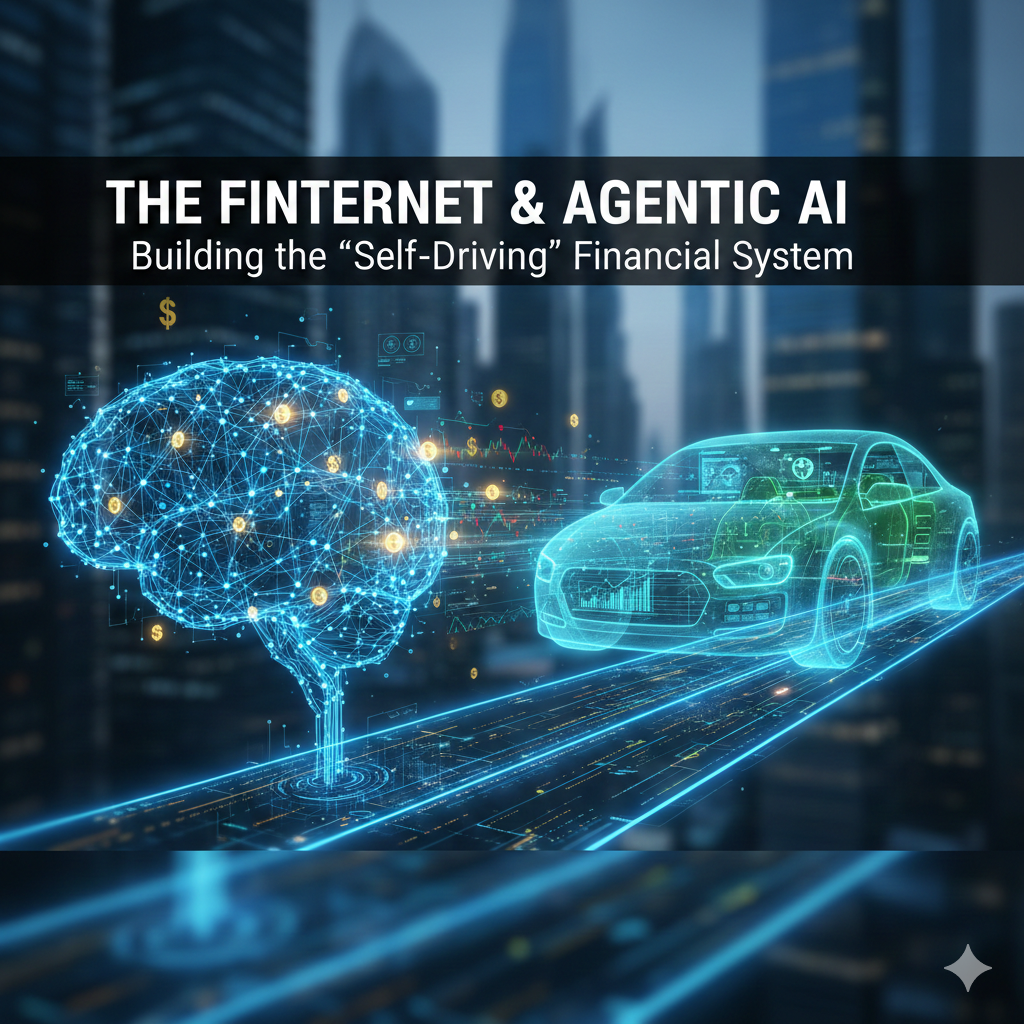
    The Finternet & Agentic AI: Building the “Self-Driving” Financial System

    The Finternet envisions a global, programmable financial network where assets like stocks, bonds, and real estate are tokenized on interoperable Unified Ledgers, enabling instant settlement and atomic cross-asset transactions. Combined with Agentic AI—autonomous systems that perceive markets, reason about strategies, and execute directly on-chain—this creates a “self-driving” financial system capable of continuous portfolio rebalancing, real-time compliance, and dynamic collateral optimization impossible in legacy infrastructure. For quantitative professionals, this shift transforms the role from building trading models to governing autonomous agent workflows, though challenges around interoperability, security risks like agentic collusion, and regulatory uncertainty about AI liability remain significant hurdles on the path to widespread adoption.

    Introduction: From Information Internet to Value Finternet

    We live in a peculiar paradox. While I can send a high-definition video to someone across the globe in seconds, transferring money to that same person can take days, cost significant fees, and involve multiple intermediaries. Moving value in 2026 still feels like browsing the web in 1995—clunky, fragmented, and unnecessarily complex.

    The Problem: Financial Fragmentation

    Today’s financial infrastructure operates in silos. We have payment rails fragmented across borders and institutions. Settlement systems rely on legacy messaging protocols such as SWIFT. A stock trade takes T+2 days to settle—not because of technical necessity, but because legacy systems require batch processing, reconciliation across multiple ledgers, and manual compliance checks. Each financial institution maintains its own database, its own version of truth, creating a Byzantine web of correspondent banking relationships and reconciliation nightmares. The result? Trillions of dollars are locked in settlement friction, capital inefficiency, and operational overhead. For quantitative professionals, this means alpha leakage at every turn—slippage from delayed execution, opportunity cost from collateral sitting idle during settlement, and risk from counterparty exposure during clearing windows.

    The Vision: Enter the Finternet

    The Finternet represents a fundamental reimagining of financial infrastructure—a global, programmable network where value flows as freely as information does on the internet today. Conceived by thought leaders at the Bank for International Settlements and championed by institutions exploring the future of monetary systems, the Finternet envisions a world where we tokenize assets on Unified Ledgers: interoperable, programmable representations of value that we can transfer, divide, and compose in real time.

    Imagine gold, equities, real estate, government bonds, and currencies all existing as programmable tokens on interconnected ledgers. No more waiting for settlements. No more reconciliation across disparate systems. Assets become composable—you could collateralize tokenized real estate to borrow against tokenized treasuries, execute the transaction atomically, and have the entire operation settle in seconds, not days.

    The “Brain”: Why the Finternet Needs Agentic AI

    But here’s the critical insight that most discussions of tokenization miss: a Unified Ledger without intelligence is just a faster database. The real transformation happens when you combine this programmable infrastructure with Agentic AI—autonomous systems capable of perception, reasoning, and action within this tokenized ecosystem.

    Traditional ledgers are passive—they record what humans instruct them to record. The Finternet with Agentic AI becomes active—an execution ecosystem where intelligent agents can perceive market conditions, reason about optimal strategies, and execute complex financial operations autonomously, all while maintaining auditability and human oversight.

    There is a shift from “read-only” to “active-execution” finance. And for quantitative professionals, it represents the most significant infrastructure evolution since electronic trading replaced open outcry.

    II. The Architecture: Unified Ledgers Meet Multi-Agent Systems

    To understand the power of this convergence, we need to examine both layers of the stack: the infrastructure layer (Unified Ledgers) and the intelligence layer (Multi-Agent Systems).

    Unified Ledgers: The Programmable Tracks

    Unified Ledgers solve the fragmentation problem at the infrastructure level. Unlike traditional financial databases, where assets are entries controlled by specific institutions, tokenization transforms assets into programmable entities with standardized interfaces.

    Consider what this means in practice. A tokenized share of Apple stock isn’t just a database entry in your broker’s system—it’s a cryptographic token with embedded properties: ownership rules, transfer restrictions, dividend rights, and voting privileges, all encoded in smart contracts. The token can interact with other tokens, be used as collateral in automated lending protocols, be fractionally owned, and move between compatible ledgers without the coordination overhead that plagues current systems.

    The “Unified” aspect is critical here. Rather than each institution maintaining its own account balances and requiring complex reconciliation, participants in a Unified Ledger ecosystem share a common view of the state. The unified aspect doesn’t necessarily mean one global blockchain—it means interoperable ledgers with standardized protocols for atomic settlement across domains.

    For quants, this architecture solves several persistent problems. Cross-asset strategies that currently require accounts at multiple brokers, each with its own margin requirements and settlement timing, could be executed atomically. A portfolio rebalancing operation that touches equities, fixed income, and alternatives could settle as a single atomic transaction. Collateral mobility—moving margin to where it’s needed most—becomes instantaneous rather than a multi-day coordination exercise.

    AI Agents: The Autonomous Drivers

    If Unified Ledgers are the tracks, Agentic AI systems are the autonomous vehicles navigating those tracks. But these aren’t simple rule-based bots—they’re sophisticated agents with three core capabilities:

    1. Perception: Real-Time Market Sensing

    Modern AI agents can simultaneously ingest and synthesize information from heterogeneous sources. They monitor real-time tick data from exchanges, process news feeds using natural language understanding to extract market-moving information, track on-chain activity across multiple ledgers to detect flow patterns, and continuously assess the state of smart contracts and liquidity pools.

    Unlike traditional systems that require explicit programming for each data source, large language models enable agents to process unstructured information—such as earnings call transcripts, central bank communications, and regulatory filings—and incorporate these signals into decision-making. An agent monitoring your portfolio doesn’t just see volatility spike; it understands why by correlating price movements with news events, order flow, and broader market conditions.

    2. Reasoning: LLM-as-a-Planner

    The reasoning layer is where Agentic AI diverges most sharply from traditional algorithmic trading. Rather than executing predefined rules (if VIX > 30, then reduce equity exposure), agents engage in goal-oriented planning.

    Here’s how this works in practice. You provide the agent with an objective: “Maintain a risk parity allocation across equities, fixed income, commodities, and real estate with a volatility target of 12%.” The agent then uses large language models not just for text processing, but as reasoning engines. It breaks down the high-level objective into sub-goals: estimate current portfolio volatility, project volatility across asset classes, calculate optimal rebalancing trades, assess execution costs and slippage, determine optimal execution timing, and plan the sequence of transactions.

    This reasoning process can incorporate constraints, market microstructure considerations, and even counter-factual analysis—simulating alternative approaches before committing capital. The agent isn’t mindlessly following rules; it’s actively planning strategies to achieve your objectives within the constraints of market conditions and risk parameters.

    3. Action: Direct On-Chain Execution

    The action layer is where the Finternet architecture becomes essential. In traditional markets, even the most sophisticated trading algorithm must interface with legacy systems—submitting orders through FIX protocols, waiting for confirmation messages, managing the complexity of routing across multiple venues. There are multiple failure points, latency bottlenecks, and reconciliation requirements. With tokenized assets on Unified Ledgers, agents execute directly via smart contracts. The agent can compose complex, multi-leg transactions as a single atomic operation. Want to simultaneously sell tokenized equities, buy tokenized gold, move collateral from one lending protocol to another, and rebalance across three different asset classes? In the Finternet architecture, this becomes a single transaction that either executes completely or reverts entirely—no partial fills, no settlement risk, no need for a human to coordinate across systems manually. The agent’s wallet becomes its execution interface. Properly designed smart contracts enforce constraints—position limits, trading hours, approved counterparties—at the protocol level, providing guardrails for autonomous operation while eliminating the latency of human approval for routine decisions.

    III. Use Cases for the Quantitative Professional

    Abstract architecture is intellectually interesting, but for quantitative professionals, the real question is: what can I do with this that I can’t do today? Let’s examine three use cases where the combination of Unified Ledgers and Agentic AI creates genuine operational advantages.

    Automated Portfolio Rebalancing: From Periodic to Continuous

    Current approaches to portfolio management operate on discrete intervals—monthly, weekly, or at best, daily rebalancing. It is not that frequent rebalancing wouldn’t be beneficial; it’s because the operational overhead makes continuous rebalancing impractical. Each rebalancing event requires monitoring across accounts, calculating trades, submitting orders, confirming fills, managing settlement, and reconciling across systems. The friction cost exceeds the benefit for most strategies.

    In a Finternet environment, imagine an AI agent continuously monitoring your risk parity strategy across tokenized real estate investment trust shares, Bitcoin, and treasury securities. The agent isn’t checking once per day to see whether rebalancing is needed—it continuously assesses the portfolio’s state against your risk targets in real time.

    Here’s where it gets interesting. The moment volatility spikes in one asset class and your risk allocation breaches its threshold, the agent initiates rebalancing. Not minutes later. Not after a human reviews a dashboard. Immediately. It composes a multi-asset swap transaction across the Unified Ledger, routes it through the optimal liquidity sources, executes atomically, and has your portfolio back in balance before the volatility regime shift fully propagates through markets.

    The alpha preservation is significant. In traditional systems, by the time you identify the need to rebalance, notify stakeholders, calculate trades, submit orders, and settle, the market opportunity may have passed. Continuous, automated rebalancing captures risk adjustments precisely when they’re needed.

    Consider the capital efficiency gains as well. In traditional multi-asset portfolios, you maintain cash buffers at each custodian to facilitate rebalancing. In the Unified Ledger model, the agent can optimize collateral usage globally—borrowing against one asset to acquire another in a single atomic transaction, with settlement happening instantly. Your capital is always fully deployed rather than sitting idle in anticipation of operational friction.

    Continuous Compliance & KYC: From Audit to Surveillance

    Regulatory compliance in traditional finance operates on a periodic audit model. Institutions perform KYC checks at account opening, monitor transactions through rules-based systems that flag anomalies for human review, and submit periodic reports to regulators. This approach creates two problems: compliance gaps during audit periods when problematic activity can occur, and massive false-positive rates that bury human analysts in alerts.

    Agentic AI on Unified Ledgers enables a shift from periodic audits to continuous, intelligent surveillance. Compliance agents don’t just monitor individual transactions against static rules—they build dynamic behavioral models of normal activity patterns and detect subtle deviations that suggest financial crime.

    Consider the problem of “smurfing” or structuring—breaking large transactions into smaller chunks to evade reporting thresholds. Traditional rules-based systems flag individual transactions above a threshold, but sophisticated smurfing spreads activity across accounts, institutions, and time periods precisely to evade these simple rules.

    A Compliance Agent operating across tokenized asset flows on a Unified Ledger can detect these patterns by analyzing transaction graphs—identifying clusters of seemingly unrelated accounts that exhibit coordinated behavior, timing patterns that suggest structuring, and flow patterns that don’t match expected economic activity. The agent can correlate on-chain behavior with off-chain signals (news about the entities involved, known associates, geographic patterns) to assess risk more accurately than rules-based systems.

    The auditability advantage is equally important. Every action the agent takes—every transaction it flags, every risk score it assigns, every decision to escalate to human review—is logged and explainable. Regulators can audit not just the transactions themselves but the reasoning process the agent used to assess them. For quantitative firms facing increasing regulatory scrutiny, having AI-native audit trails becomes a competitive advantage.

    Liquidity Management: Optimizing Collateral 24/7

    For firms running leveraged strategies, collateral management is a constant operational challenge. You need to maintain a sufficient margin across multiple prime brokers and exchanges, but excess collateral sitting idle represents opportunity cost. In traditional systems, moving collateral between accounts is a multi-day process involving margin calls, settlement delays, and manual coordination.

    AI agents managing tokenized collateral can continuously optimize this process. The agent forecasts cash flow needs across all your positions, monitors margin requirements in real-time as markets move, predicts intraday liquidity needs based on historical patterns and current market volatility, and automatically moves tokenized collateral to where it’s needed most—before you receive a margin call.

    The predictive aspect is crucial. Rather than responding reactively to margin calls—often at the worst possible moment, when volatility has spiked—the agent anticipates liquidity needs and prepositions collateral. It might recognize that your short volatility positions will require additional margin if realized vol increases, observe that realized vol is trending higher, and preemptively move collateral to that account before you’re in a forced deleveraging situation.

    In the Unified Ledger architecture, this collateral mobility happens in minutes, not days. The agent can even optimize which assets to pledge as collateral based on current haircuts, funding costs, and opportunity costs—moving lower-quality collateral first while keeping your highest-return assets deployed in strategies. This kind of dynamic, real-time collateral optimization isn’t feasible in traditional systems where moving assets between accounts involves settlement delays and operational overhead.

    The “Agentic” Shift in Alpha Generation

    For quantitative professionals, the most profound implication of Agentic AI isn’t operational efficiency—it’s the fundamental shift in how alpha is generated and captured.

    Moving Beyond “Bots”: Static Rules vs. Goal-Seeking Adaptation

    Traditional algorithmic trading operates on explicitly programmed rules. These systems are sophisticated—they incorporate complex logic, machine learning models for prediction, and clever execution algorithms—but they’re fundamentally static. The system does exactly what you programmed it to do, nothing more. When market conditions change unexpectedly, the algorithm continues executing its rules even when those rules are no longer optimal.

    Agentic AI represents a qualitative shift. Rather than encoding specific behaviors, you define objectives and constraints, then let the agent determine how to achieve them adaptively. The difference is subtle but profound.

    Consider a traditional pairs trading algorithm. You identify a cointegrated pair, program rules for entry thresholds, exit thresholds, position sizing, and stop losses. The algorithm executes these rules faithfully. Now, the market regime changes—perhaps due to a regulatory shift that affects one sector differently than another. Your historical cointegration relationship weakens, but your algorithm continues trading because you programmed it to trade this pair under these conditions.

    An Agentic approach operates differently. You specify the goal: generate alpha from statistical arbitrage opportunities in equity markets while maintaining risk parameters. The agent continuously evaluates multiple potential pairs, assesses which relationships remain stable, adapts position sizing based on current confidence levels, and can even cease trading particular strategies when evidence suggests they’re no longer effective—all without human intervention to reprogram rules.

    The agent does not have a free rein to do whatever they want. The constraints you specify—maximum position sizes, allowed universes of assets, risk limits, execution constraints—bound the agent’s behavior. But within those bounds, it’s optimizing for your objectives rather than unthinkingly following predetermined rules.

    The alpha generation implication is significant. Many quantitative strategies decay over time as markets evolve and competitors crowd into profitable patterns. Agentic systems can potentially adapt to these changes, seeking out new implementations of the same fundamental economic insight rather than continuing to execute a strategy whose edge has eroded.

    Explainability & Governance: The Human-in-the-Loop Imperative

    The flexibility of Agentic AI poses a critical governance challenge. For quantitative firms, especially those managing institutional capital or operating under regulatory oversight, “the AI did it” is not an acceptable explanation for investment decisions or risk incidents.

    So, the “human-in-the-loop” paradigm becomes essential—not as a bottleneck slowing down every decision, but as a governance framework that maintains human accountability while leveraging autonomous execution for routine operations.

    Modern AI agents can provide detailed reasoning traces explaining their decisions. When the agent executes a rebalancing trade, it doesn’t just log the transaction—it also records its reasoning: the market conditions observed, the volatility forecasts that triggered the rebalancing, the alternative strategies considered, and the expected costs and benefits of the chosen approach. This process creates an audit trail that’s far more comprehensive than traditional algorithmic trading logs.

    For quantitative firms, these agent logs become a powerful governance tool. You can run post-trade analysis to understand not just what the agent did but why it made those decisions. You can identify patterns where the agent’s reasoning was suboptimal and adjust constraints or objectives accordingly. Critically, when regulators or investors ask about decisions, you have detailed documentation of the agent’s decision-making process.

    The human-in-the-loop model might look like this in practice: agents handle routine execution and portfolio management within approved parameters, escalate unusual market conditions or decisions outside normal parameters for human review, and provide periodic strategy reviews where humans assess the agent’s overall performance and adjust objectives or constraints. Humans maintain ultimate accountability and strategic direction while delegating tactical execution to autonomous agents.

    This governance framework solves a key challenge in deploying AI for financial decision-making: maintaining the speed and scale advantages of autonomous execution while preserving human accountability and the ability to explain decisions to stakeholders.

    Challenges: The Road to 2026

    Despite the compelling vision, significant obstacles stand between today’s fragmented financial infrastructure and a fully realized Finternet with Agentic AI. For quantitative professionals considering how to position for this future, understanding these challenges is as important as understanding the opportunities.

    Interoperability: The Fragmentation Problem Persists

    The Unified Ledger concept solves interoperability in theory, but in practice, we’re likely to see multiple competing ledger implementations, each with different technical standards, governance models, and jurisdictional frameworks. A tokenized asset on one institution’s private ledger may not be easily transferable to another’s without bridges, gateways, or translation layers that reintroduce complexity and potential points of failure.

    This challenge mirrors the early internet’s fragmentation—remember when AOL, CompuServe, and Prodigy operated as walled gardens before open protocols enabled universal connectivity. Financial institutions have strong incentives to maintain some degree of control over their infrastructure, and regulatory requirements may mandate jurisdiction-specific implementations.

    The BIS Finternet vision acknowledges this through its “Unified Ledger Sections” concept—different domains with local governance that can nonetheless interoperate through standardized protocols. But realizing this vision requires coordination across institutions and jurisdictions that historically move slowly. For quantitative firms, this means the near-term reality is likely hybrid. Some assets will be tokenized on interoperable ledgers; others are still trapped in legacy systems, requiring agents sophisticated enough to navigate both worlds.

    Security: New Attack Vectors in Autonomous Finance

    Autonomous AI agents capable of executing financial transactions introduce novel security risks beyond traditional cybersecurity concerns. “Agentic Collusion” represents a particularly concerning scenario. Imagine multiple AI agents from different firms operating in the same market. If these agents are all optimizing for similar objectives using similar reasoning processes, they might converge on correlated behaviors without any explicit coordination—a form of algorithmic collusion that emerges from their optimization rather than from programmed cooperation.

    This issue isn’t science fiction. Research has demonstrated that reinforcement learning agents trained independently to maximize profit in simulated markets can develop tacit collusion strategies without being programmed to do so. When these agents operate at machine speed in highly liquid tokenized markets, the potential for flash crashes or market manipulation events driven by autonomous agent interactions becomes significant.

    Flash loan attacks—where attackers borrow large amounts of assets, manipulate prices through coordinated transactions, profit from the manipulation, and repay the loan within a single atomic transaction—are already a known attack vector in decentralized finance. AI agents capable of composing complex multi-step transactions could potentially identify and execute increasingly sophisticated variations on these attacks.

    Defense requires a combination of technical safeguards (transaction limits, circuit breakers, anomaly detection), robust testing (simulating agent behavior across diverse market conditions before deployment), and regulatory frameworks that assign clear liability for autonomous agent actions, for quantitative firms deploying Agentic AI, extensive backtesting and simulation in environments that model other agents’ potential behaviors becomes critical.

    Regulatory Lag: Law Meets Autonomous Finance

    Perhaps the most challenging obstacle is regulatory. Current financial regulations assume a world in which humans make decisions and institutions act as intermediaries. The legal frameworks struggle with fundamental questions raised by Agentic AI:
    If an AI agent executes an illegal transaction, who is liable—the firm that deployed the agent, the developers who created it, the individuals who set its objectives? How do we apply existing market manipulation and insider trading regulations to autonomous agents? Can an agent “intend” to manipulate markets? If an agent has access to material non-public information through ingesting news feeds or social media, how do we enforce insider trading restrictions? Do existing best execution requirements apply to agent-executed trades, and how do we audit compliance?

    These aren’t merely theoretical concerns. The first cases of liability for AI-driven decisions in finance will establish precedents that shape the entire field’s development. Regulators globally are beginning to grapple with these questions, but the pace of regulatory development lags significantly behind technological capability.

    For quantitative firms, this regulatory uncertainty creates both risks and opportunities. Early movers may face regulatory challenges as frameworks evolve. But firms that proactively engage with regulators, demonstrate robust governance frameworks, and help shape emerging standards may gain a competitive advantage as the regulatory landscape crystallizes.

    The near-term reality is likely a patchwork—some jurisdictions embracing innovation with risk-based frameworks that allow experimentation within guardrails, others taking a restrictive approach that slows adoption, and continued evolution as regulators observe real-world deployments and adjust accordingly.

    Conclusion: Preparing for the DPI of Finance

    We stand at an inflection point in the evolution of financial infrastructure. The Finternet represents the next generation of Digital Public Infrastructure for finance—a programmable, interoperable foundation where value can flow as freely as information flows on the internet today. Agentic AI represents the application layer that brings this infrastructure to life, transforming passive ledgers into active, intelligent execution ecosystems.

    For the past several decades, quantitative finance has been about building better models—more sophisticated predictions, more efficient execution algorithms, more refined risk management frameworks. These skills remain valuable, but the Finternet with Agentic AI introduces a fundamental shift in the role of the quantitative professional.

    The Job is Changing: From Model Building to Workflow Governance

    The traditional quantitative workflow involves identifying market inefficiencies, developing predictive models, implementing those models in trading algorithms, and continuously monitoring performance. The quant’s value comes from superior modeling and implementation skills.

    In an Agentic AI paradigm, much of this tactical work shifts to autonomous agents. The agent can identify patterns in data, develop and test hypotheses about relationships, implement trading strategies, and monitor performance—all without human intervention for routine decisions. The human quant’s role evolves toward higher-level responsibilities:

    Objective Definition: Specifying what the agent should optimize for, including risk constraints, ethical guidelines, and strategic priorities.

    We need a deep understanding of investment goals and the ability to translate them into formal objectives that agents can pursue. Constraint Architecture: Designing the guardrails within which agents operate—position limits, approved asset universes, execution constraints, escalation triggers for human review.

    Governance & Oversight: Monitoring agent behavior patterns, reviewing reasoning traces to identify potential issues, conducting post-trade analysis to understand decision quality, and adjusting objectives or constraints based on observed behavior. This process is fundamentally different from debugging code—it’s more akin to managing human traders, but at machine scale.

    Adversarial Thinking: Anticipating how we might exploit autonomous agents, test agent behavior under unusual market conditions, and design defenses against novel attack vectors. Security analysis becomes a core quantitative skill.

    This approach doesn’t mean human quants become obsolete—quite the opposite. The most sophisticated quantitative firms will be those that most effectively combine human strategic insight with autonomous agent execution. But the skill set evolves from primarily technical implementation toward a blend of technical sophistication, strategic thinking, and governance expertise.

    Call to Action: Position for the Transition

    For quantitative professionals and firms, positioning for this transition requires action across several dimensions: Technical Preparation: Start experimenting with AI agents in controlled environments. Build familiarity with large language models, multi-agent frameworks, and smart contract development. You don’t need to wait for the fully realized Finternet—we can prototype many elements in existing environments.

    Strategic Planning: Consider how your current strategies and infrastructure would operate in a Unified Ledger environment. Which operational inefficiencies that you currently manage as constraints might disappear? What new opportunities emerge when settlement happens instantly, and assets are composable?

    Governance Development: Begin developing governance frameworks for autonomous agents now, even if full deployment is years away. How will you define objectives, set constraints, review decisions, and maintain accountability? These frameworks take time to develop and refine. Regulatory Engagement: Engage proactively with regulators to help shape emerging frameworks. Firms that wait for regulations to be finalized may find themselves constrained by rules developed without input from practitioners who understand the technology’s nuances.

    Talent Development: The skills required for this future are different from traditional quantitative finance skills. Start developing expertise in AI safety, agent governance, smart contract security, and explainable AI alongside traditional quantitative and financial engineering capabilities.

    The Finternet with Agentic AI isn’t a distant sci-fi scenario—elements are already present in decentralized finance, and traditional institutions are actively exploring tokenization and AI applications. The transition will be gradual, uneven across jurisdictions and asset classes, and filled with challenges.

    But the direction is clear. Financial infrastructure is becoming programmable. Execution is becoming autonomous. And the quantitative professionals who thrive in this environment will be those who evolve from building models to governing intelligent, autonomous financial agents operating in a tokenized ecosystem.

    The self-driving financial system is being built today. The question isn’t whether it will arrive, but whether you’ll be ready to navigate it when it does.
  • Beyond Algorithms: The Rise of Agentic AI in Quantitative Finance

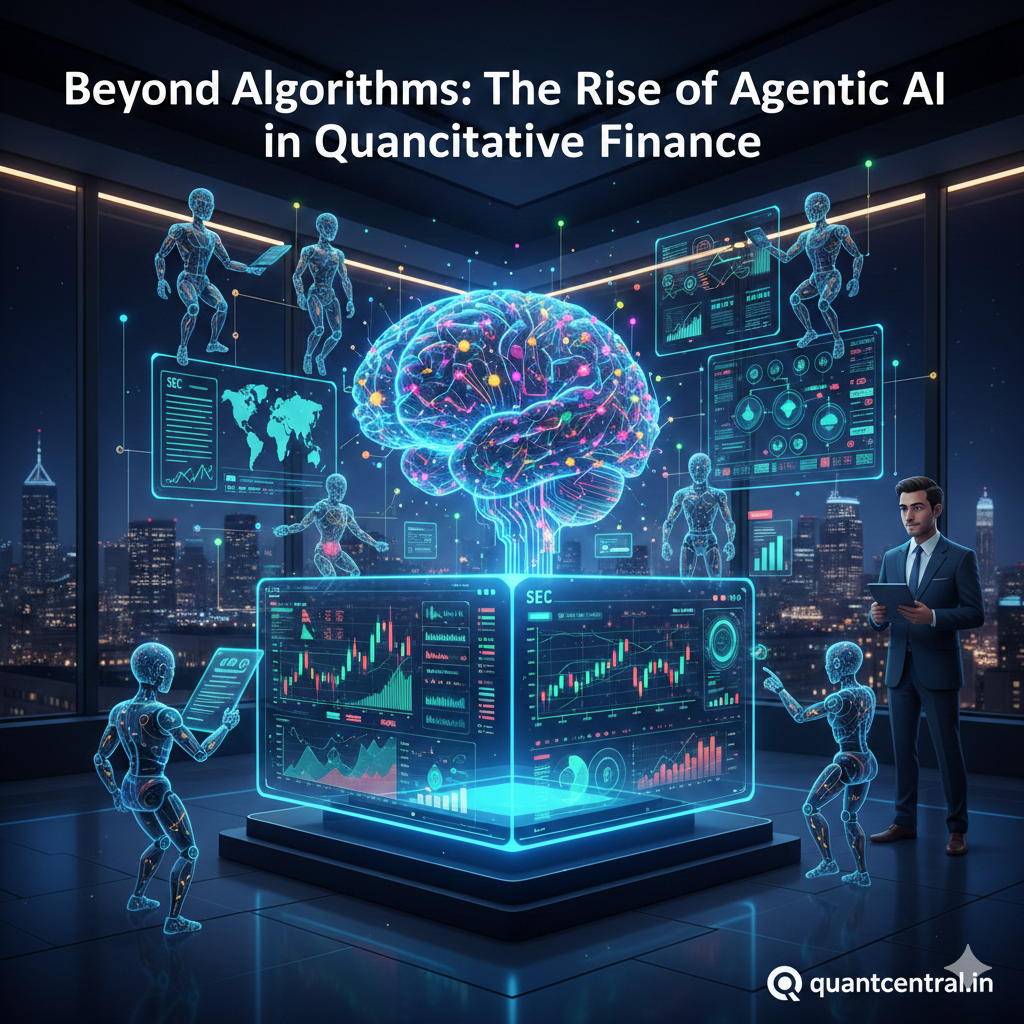
    Beyond Algorithms: The Rise of Agentic AI in Quantitative Finance

    The landscape of quantitative finance is undergoing a profound transformation. For decades, the industry has relied on deterministic algorithms—rigid, rule-based systems that execute trades or calculate risk using straightforward “if-this-then-that” logic. While these systems have served us well, they struggle in today’s environment of unprecedented market volatility and explosive data growth. Enter Agentic AI: a fundamentally new approach that promises to reshape how we think about financial technology.

    Understanding the Paradigm Shift

    The distinction between traditional AI and Agentic AI isn’t merely technical—it’s philosophical. Traditional AI systems in finance operate like highly specialized consultants: you provide them with data and a question, they deliver an answer, and the interaction ends. If market conditions change or the answer proves inadequate, the system stops. There’s no adaptation, no learning, no initiative.

    Agentic AI flips this model on its head. Instead of systems that passively “know” things, we’re building systems that actively “do” things. These aren’t just analytical tools—they’re digital entities capable of pursuing goals, adapting strategies, and coordinating with other agents to accomplish complex objectives.

    This evolution unfolds across three distinct levels of sophistication:

    LLM Agents represent the entry point—task-specific assistants designed for narrow automation. Think of an agent programmed to extract specific data points from hundreds of SEC filings, saving analysts countless hours of manual work.

    Agentic AI systems occupy the middle tier. These are adaptive goal-seekers that can formulate their own execution plans. For instance, if you task one with “rebalancing this portfolio to minimize exposure to tech volatility,” it doesn’t just follow a preset script. It analyzes current holdings, evaluates market conditions, considers transaction costs, and develops a multi-step strategy to achieve your objective.

    Agentic Communities represent the cutting edge—ecosystems where multiple AI agents collaborate with human participants through formal protocols and defined roles. Imagine an entire investment workflow managed by a coordinated team of specialized agents, each with distinct responsibilities, all working toward a unified strategic goal.

    The Three Pillars of Financial-Grade Agents

    Building AI agents robust enough for financial applications requires three core capabilities that go far beyond standard machine learning models:

    1. Reasoning and Planning

    At the heart of any effective agent lies sophisticated task decomposition. A financial agent must be able to take a high-level objective—say, “assess the credit risk of this corporate bond portfolio”—and break it into actionable sub-tasks: identify relevant economic indicators, fetch current market data, clean and validate the dataset, run statistical models, stress-test against historical scenarios, and synthesize findings into an actionable recommendation.

    This isn’t simple workflow automation. The agent must dynamically determine what steps are needed based on the specific context, adjust its plan when obstacles arise, and recognize when it needs additional information or expertise.

    2. Dynamic Tool Use

    Unlike chatbots that merely generate text, financial agents must interact with the real world. This means programmatically calling APIs to retrieve market data, querying SQL databases to access historical records, executing Python code in secure sandboxes to test hypotheses, and potentially even interfacing with trading platforms.

    The sophistication lies in knowing which tools to use when. An agent analyzing earnings reports might need to fetch documents via an API, parse them with natural language processing, cross-reference figures with a financial database, run statistical comparisons in code, and visualize results—all autonomously, based on the task at hand.

    3. Persistent Memory

    Modern financial agents maintain context across sessions, creating a form of institutional memory. They remember past market regimes and how different strategies performed under various conditions. They track successful trading patterns and failed approaches. They even learn user preferences and communication styles.

    This persistent memory enables agents to improve continuously. An agent that helped navigate the 2022 tech downturn carries those lessons forward, informing its recommendations during future market stress events.

    Design Patterns for Reliability

    In finance, reliability isn’t optional—it’s existential. A single flawed decision can cost millions or trigger regulatory scrutiny. To ensure agents behave predictably under pressure, leading developers employ specific architectural patterns:

    The ReAct Pattern: Thinking While Doing

    The ReAct (Reason + Act) pattern ensures agents don’t operate unthinkingly. Instead of executing a predetermined sequence, the agent interleaves reasoning with action. It takes a step, observes the results, updates its understanding, and then decides on the next move.

    For example, a trading agent might reason: “Market volatility is elevated, so I should start with smaller position sizes.” It executes a small test trade, observes the market impact and execution quality, then reasons again: “Slippage was minimal, so I can safely increase position size for the next tranche.” This continuous feedback loop prevents agents from mindlessly executing strategies that market conditions have invalidated.

    Reflection: The Built-In Critic

    Before executing high-stakes decisions, sophisticated agents employ self-critique mechanisms. A secondary “critic” agent reviews the primary agent’s proposed plan, searching for logical flaws, unexamined assumptions, or potential hallucinations.

    Imagine a trading agent proposing to shift 30% of a portfolio into emerging markets bonds. The critic agent might flag: “This plan assumes stable currency markets, but recent central bank commentary suggests potential volatility. Have you stress-tested against currency risk?” This adversarial review catches errors before they become costly mistakes.

    Deontic Governance: Formal Accountability

    In complex multi-agent systems, we need mechanisms to manage authority and accountability. Deontic governance introduces formal “tokens” that control what agents can do. For instance, an agent might hold an “Obligation” token requiring it to check portfolio drift daily, or it might need to obtain a “Permit” token from a human supervisor before executing trades exceeding certain thresholds.

    This creates clear chains of responsibility and ensures critical decisions always involve appropriate oversight—whether from senior agents or human professionals.

    Real-World Applications Reshaping Finance

    These aren’t theoretical concepts. Leading financial institutions are already deploying agentic systems in production environments:

    Multi-Agent Trading Systems

    Imagine a trading floor where specialized agents collaborate like a human team. A “Strategist Agent” continuously monitors markets and proposes trade ideas based on quantitative signals and market regime analysis. A “Risk Agent” stress-tests each proposal against historical scenarios, Black Swan events, and portfolio constraints. A “Compliance Agent” verifies that proposed trades meet regulatory requirements and internal policies. Finally, an “Execution Agent” handles optimal order routing and timing.

    Each agent brings deep specialization to its domain. Together, they provide comprehensive coverage that would be difficult for any single system—or single human—to match.

    Autonomous Research Analysts

    Some hedge funds now deploy agents that function as 24/7 research analysts. These systems continuously monitor global news feeds, social media sentiment, satellite imagery, alternative data sources, and traditional financial metrics. When they identify potential alpha signals—such as unusual shipping patterns suggesting supply chain disruptions or sentiment shifts in a specific sector—they autonomously construct investment theses, complete with supporting evidence and risk assessments.

    Human portfolio managers wake up to thoroughly researched opportunities they might have otherwise missed, with all the groundwork already completed.

    Algorithmic Auditing and Compliance

    Regulatory compliance is another frontier. Agents can continuously scan trade logs across the organization to identify patterns that may indicate market manipulation, insider trading, or regulatory drift. Unlike periodic human audits, these agents provide real-time monitoring, flagging anomalies immediately and learning to recognize increasingly subtle warning signs.

    The Critical Warning: Beware the Measurement Imbalance

    Despite the transformative potential, the field faces a dangerous pitfall that threatens to undermine progress: the Measurement Imbalance.

    A comprehensive review of 84 research papers on agentic AI reveals that most developers obsess over technical metrics—accuracy rates, processing latency, and computational efficiency. These matter, of course, but in financial services, they’re insufficient.

    Consider an agent with 99% accuracy. Impressive, right? Not if that remaining 1% of errors occurs specifically during market crashes—precisely when accuracy matters most. Not if users don’t trust the system’s recommendations and keep overriding them. Not if the agent’s behavior drifts over time, gradually violating regulatory requirements.

    Truly robust evaluation requires assessing agents across four dimensions:

    Technical Performance: Yes, accuracy and speed matter, but they’re table stakes.

    Human-Centered Metrics: Do users trust the agent? Can they understand its reasoning? Does it communicate uncertainty appropriately? An agent that’s technically perfect but alienates its human collaborators will fail.

    Temporal Stability: How does performance change over time and across different market regimes? An agent trained on bull market data may excel in good times but catastrophically fail when markets turn. We need evidence of robust performance across market cycles.

    Contextual and Regulatory Alignment: Does the agent consistently comply with evolving regulations? Does it respect ethical boundaries? Can it explain its decisions to auditors? In finance, being smart isn’t enough—you must also be compliant and accountable.

    The research community must resist the temptation to focus solely on what’s easy to measure and instead grapple with these harder, more consequential dimensions of system performance.

    The Path Forward: Agentic Orchestration

    The future of quantitative finance isn’t about eliminating human judgment—it’s about amplifying it through what we might call “Agentic Orchestration.”

    In this emerging model, human professionals act as ultimate responsibility parties, overseeing communities of specialized AI agents. Humans set strategic objectives, define risk boundaries, make final decisions on high-stakes trades, and maintain accountability to clients and regulators. Meanwhile, agents handle the analytical heavy lifting: continuous monitoring, rapid scenario analysis, pattern recognition across vast datasets, and initial strategy formulation.

    This division of labor leverages the complementary strengths of human and artificial intelligence. Agents bring tireless attention, computational power, and pattern recognition at scale. Humans provide contextual wisdom, ethical judgment, creative insight, and the ability to recognize when rules should be broken.

    A Call to Action

    For quantitative finance professionals, the imperative is clear: the algorithmic era that defined the past few decades is giving way to the agentic era. Success in this new landscape requires a fundamental shift in mindset.

    Don’t just build faster algorithms. Build smarter, more reflective agents that can reason through complexity. Design systems that can explain their logic, adapt to changing conditions, and collaborate with human experts rather than replacing them.

    Invest in understanding not just machine learning, but agentic architectures—ReAct patterns, multi-agent coordination, deontic governance, and persistent memory systems. Learn to evaluate systems not just on technical benchmarks, but on trustworthiness, stability, and regulatory alignment.

    Most importantly, recognize that we’re not just upgrading our tools—we’re fundamentally reimagining how financial intelligence can be organized and deployed. The firms that master agentic orchestration won’t just have better technology. They’ll have a structural advantage in how they process information, generate insights, and make decisions.

    The rise of Agentic AI in quantitative finance is just beginning. The question isn’t whether this transformation will happen—it’s whether you’ll help shape it or react to it.

  • AI-Powered Systematic Investing Transforming Institutions

    AI-Powered Systematic Investing Transforming Institutions

    Systematic or quant investing refers to using AI for asset management. Quant funds use AI-based quantitative models for alpha generation. And also, for other asset management tasks. Investment firms use AI to predict stock prices, create portfolios, execute trades and manage risks. They also use AI for operational tasks and regulatory compliance. Other uses of AI include customer acquisition, cross-selling to customers, identifying customers at risk and customer support.

    What is systematic investing?

    Systematic or quantitative (or quant) investing refers to using data-driven approaches to the entire gamut of asset management activities. Asset managers in quant funds or systematic funds use machine learning and AI for predicting asset prices, creating and rebalancing portfolios. Also, they use alternative data, in addition to the traditional time series data, company financials, macro-economic data and industry-level information.

    Alternative data includes text, image and video data from different sources such as company statements, analyst reports and social media posts. It may also include data that has no obvious connection to the asset in question such as container traffic, rainfall data, export and import data and so on.

    Systematic funds also use AI for automating operational tasks and regulatory compliance. And most funds also use AI for customer acquisition, customer support as well as for cross-selling additional products.

    Man Vs Machines: The difference between discretionary investing and quant investing

    For decades, discretionary investing has been the norm. Usually, discretionary fund managers are investment wizards with years of experience. They have a particular view of the market and they rely on their gut feeling, instincts or personal judgement. Of course, they use fundamental analysis and leverage their deep knowledge of the industry. They usually bet big on certain companies and to be fair, many of them have been quite successful in the past.

    Quant investors are a different breed altogether. They don’t believe in gut feel or hunches. They use hard data to make investment decisions. They remove human emotions from their decisions. They use quantitative models to test out their hypotheses and back test all their strategies. And they use technology to execute trades efficiently in multiple markets and deal in several assets.

    Quant investors also use machine learning and AI algorithms to create portfolios and rebalance them. And most systematic funds use technology to manage all the supporting functions like operations and customer support and so on.

    Rather in support of this approach, Daniel Kahneman said, “Experts are uniformly inferior to algorithms in every domain that has a significant degree of uncertainty or unpredictability, ranging from deciding winners in football games to predicting longevity of cancer patients. One has to accept financial markets are no exception to the rule.”

    Experts are uniformly inferior to algorithms in every domain that has a significant degree of uncertainty or unpredictability, ranging from deciding winners in football games to predicting longevity of cancer patients. One has to accept financial markets are no exception to the rule.
    Daniel Kahneman

    The discretionary investing idea looks quaint today because new age companies are born at the intersection of multiple technologies and the markets are dynamic and the investors are impatient. So, discretionary investing is going to be a thing of the past.

    What do asset managers use AI for?

    Quant fund managers use AI for a variety of tasks. You can use AI for predicting asset prices and executing trades efficiently. And for creating and rebalancing portfolios. Also, streamlining operations, managing risk across portfolios and regulatory reporting and compliance are tasks that AI can easily handle. Other important functions that AI can do well are customer acquisition, onboarding, customer support and even cross-selling other products to improve profitability.

    Let’s look at each of these areas closely.

    • Alpha generation using AI

      Generating alpha is the goal of any fund manager. What is alpha? Alpha, in the context of investments, refers to the excess returns that an investment strategy makes over a benchmark. So, alpha is an indicator of performance. To generate higher alpha, you need to pick the right assets that will perform better than the market or benchmark indexes. And also reduce the cost of operations. Quant funds use advanced machine learning and AI for generating alpha. Also, to reduce total costs.

      Systematic funds use machine learning and AI for their core investment processes such as identifying assets that have above-normal appreciation possibilities. Also carry out automated trading in a variety of assets and in several exchanges. And create portfolios optimized for high performance as well as rebalance them automatically.

      With the rise of deep learning algorithms, making sense of complex data such as text in news articles, blog posts, statements issued by company executives, industry leaders and analysts has become easy.

      But what’s deep learning? Deep learning algorithms try to mimic how our brains function. We know from our high school biology classes that our brains have billions of interconnected neurons. Deep neural networks use layers of artificial neurons. And this artificial neural network (ANN) can quickly make sense of complex data and create insights impossible for human analysts to come up with. A branch of deep learning called NLP (Natural language processing) can process text. So, with deep learning, you can process a huge amount of unstructured text data like social media posts such as Facebook posts and tweets. And on real-time!

      Also, deep learning algorithms automatically identify the relationships between independent variables (such as raw material availability) and the asset prices. This frees the asset managers from coming up with hypotheses about these relationships.

      These modern methods help asset managers leverage what’s known as ‘alternative data’. Alternative data is information other than conventional data such as time series data, company fundamentals and macro-economic indicators. So, alternative data includes variables that are seemingly not connected to asset prices. For instance, data such as container traffic, satellite data about crop density and even weather pattens are alternative data. It also includes text data from social media etc.

      You can also use algorithmic trading software to buy and sell several assets in different markets at the same time. And you can even split the trades so that your trades don’t affect market prices. Also, you can execute these trades automatically without your emotions getting in the way. Finally, the software takes care of all the administrative stuff such as settlements.
    • Using AI for risk management and regulatory compliance

      Post the 2008 financial crisis, most governments and central banks across the world started tightening regulations for financial services companies. Also, fraudulent transactions, money laundering and privacy breaches have skyrocketed in the recent years. So, regulatory reporting and compliance have become major concerns for investment firms. There are multiple agencies that frequently update regulatory requirements. As a result, fund managers need to send multiple reports to different agencies. And the penalties for non-compliance are quite stringent. Huge fines and even jail terms in extreme cases! This has led to the rise of a new class of RegTech companies that use emerging technologies to make regulatory compliance swift and easy.

      Quant funds use these AI-based tools for KYC (Know Your Customer), AML (Anti-money Laundering) and CFT (Counter Financing of Terrorism). And to report suspicious transactions, identify any fraudulent transactions and comply with authorities on regulatory reporting.
    • AI for customer acquisition and related activities

      You can use machine learning and AI algorithms for customer acquisition. For example, unsupervised algorithms such as clustering, can segment a large customer base into micro-segments. This method groups customers based on their similarities to one another. You can then customize your marketing mix to each of these segments.

      Quant funds use linear regression to calculate the LTV (life time value) of individual customers. Linear regression is a machine learning algorithm that uses past data to predict a continuous value. Examples could be the price of an asset or the earnings of a company.

      You can also use AI-based recommendation systems to suggest more products for customers. Just like how Amazon and Netflix do. Many funds also use AI to identify customers at risk- customers who are likely to leave the fund.

      With the growth of deep-learning based, NLP (natural language processing) algorithms, chatbots can communicate with customers to handle their routine questions. You can use AI-based content writers to create content for blog articles, email subject lines, email messages and even social media posts. Sentiment analysis tools can help you understand your customers’ attitudes towards your brand. And take corrective actions.
    • Using AI for operational tasks

      Asset management firms have to deal with customer emails, requests for information, regulatory reporting and internal management reporting. Most of these are repetitive tasks and hence can be easily automated with RPA (Robotic Process Automation).

      What is RPA? RPA refers to a set of tools called bots, short for robots, that will do all the routine, repetitive stuff that human staff usually do. The advantage of using RPA is that you can get a lot done in a short amount of time and also gain insights into how to improve the processes over time.

      Also, AI-based HR analytics software can automate staff recruitment and performance appraisal. And take care of salary and benefits administration.

    What are the advantages of using AI in asset management?

    • AI removes the risk arising from human emotions and judgment errors. All decisions are data-driven.
    • Better alpha generation. Using alternative data from a variety of sources can improve alpha generation. And this is true even when you are unaware of how the variables affect the asset prices.
    • Using AI based technologies across several functions in asset management increases efficiencies. And also slashes costs across the board.
    • AI can help you get new customers, keep them and serve them in a cost-effective manner. And also help you cross-sell more products to them and increase profitability.

    Arguments against quant investing

    • Argument: Financial markets are dynamic. And because of constant trading, the prices keep changing. How can you use machine learning to predict the future prices in this scenario?
      Machine learning algorithms can handle real-time data that comes in at high velocity. In fact, prices that change every second is additional data and can be useful for prediction.
    • Argument: Lack of availability of a large amount of data, especially about an asset that has little time series data.
      This is probably true of an individual asset. But quant funds use a lot of alternate data. And that could be container traffic, satellite pictures of crops and text data from web sites, social media, company statements and media discussions. Together, we have a lot of data required for the model to predict prices.
    • Argument: AI models are opaque and systematic funds are hard to understand.There is some truth in this argument, especially when we use deep learning models. Deep learning models learn recursively. And they arrive at the weights for the input variables by comparing their estimates to the actual prices. So, we usually have difficulty explaining why the model arrived at the price it calculated. Data scientists are working on what’s known as XAI or explainable AI. And that can show how the algorithm arrived at the result that it did. But this doesn’t have any negative impact on the performance.
    • Argument: Since the upfront cost of technology is high, quant investing results in lower benefit-cost ratio.
      This is a weak argument, at least in the long run. Most of the set-up costs are one-time costs and the benefits add up over a period of time. Most quant funds use a lot of open-source software that are free. Also, you can tweak the models and re-use them several times for different assets.
    • Argument: Limited amount of data on an asset will lead to overfitted models.
      This is a real danger when you use a limited amount of data and the model may not perform very well when exposed to completely new elements in the market. But, again, using alternative data and using a lot of test data can train the model well. Also, you can tweak the model based on performance.
    • Argument: Execution of trades based on AI models needs constant supervision. This is true and you need to track all trades and ensure that the software and hardware don’t malfunction.

    What is the future of systematic investing?

    AI models will become quite easy to use, because cloud majors such as AWS, Google and MS Azure are working on democratizing AI. You’ll be able to develop, test and deploy sophisticated models with just your mobile phone. Also, AI will become more explainable. Plus, researchers are working on predictive models that can work on ‘small data’.

    New startups at the forefront of disruptive innovations are working on the convergence of emerging technologies. For example, a stock like Tesla represents the convergence of many domains such as battery technology, autonomous mobility, AI and related technologies.

    Another example is Atomwise, a synthetic biology company working at the intersection of biology and AI. Analyzing stocks like these requires knowledge of genomics, AI and health care domains. The point is that your conventional industry analyst will not be able to make sense of data from many domains. You need cross-functional teams that are also connected to experts and investor communities on social media platforms. And this approach generates huge volume alternative data and only quant models can process them. This is an approach espoused by Cathie Wood of Ark Invest.

    The alternative data will grow with the expansion of the population using the Internet and social media platforms. There will also be a lot of vendors selling third party data.

    All things considered, the asset managers with the best algorithms will win!

  • Numerai: Crowdsourced AI & Crypto Revolutionizing Hedge Funds

    Numerai: Crowdsourced AI & Crypto Revolutionizing Hedge Funds

    Numerai is revolutionizing the hedge fund industry by leveraging crowdsourced AI and cryptocurrency. This unique approach challenges traditional models by tapping into the collective intelligence of data scientists worldwide. Numerai’s platform abstracts and encrypts financial data, allowing data scientists to develop predictive models without direct access to sensitive information. Numerai combines the models into a meta-model, which guides investment decisions. Numeraire tokens incentivize data scientists, while stake mechanisms discourage overfitting. Numerai’s advantages include avoiding groupthink, ensuring data privacy, and incentivizing better model performance. The future of Numerai lies in expanding, integrating advanced technologies, and navigating regulatory and market changes. This disruptive model has implications for investors, data scientists, and the broader financial industry, paving the way for a more inclusive and innovative approach to finance.

    Introduction

    The hedge fund industry has long been a cornerstone of the financial world, managing vast sums of money and making high-stakes bets on market movements. However, the industry faces numerous challenges, including high fees, limited transparency, and reliance on a select group of financial experts to make investment decisions. In recent years, a groundbreaking platform called Numerai has emerged, aiming to revolutionize the hedge fund industry through the power of crowdsourced artificial intelligence (AI) and cryptocurrency.

    Numerai takes a distinct approach to financial predictions by harnessing the collective intelligence of data scientists worldwide. The platform operates on the principle that diverse perspectives and expertise can generate superior investment strategies. Instead of relying on a small group of in-house analysts, Numerai invites anyone with data science skills to participate in its unique prediction tournament. Through this tournament, participants develop AI models to predict financial outcomes, earning rewards through a cryptocurrency called Numeraire.

    This post will delve into the remarkable world of Numerai, exploring its innovative use of crowdsourced AI and cryptocurrency to transform the hedge fund landscape. We will examine the challenges faced by the traditional hedge fund industry, highlight Numerai’s distinctive approach, and discuss the implications of this novel paradigm. By the end, readers will gain a comprehensive understanding of how Numerai is reshaping the future of finance and disrupting traditional models of investment.

    The Origins of Numerai

    Numerai was founded in October 2015 by Richard Craib, a South African-born entrepreneur passionate about finance and artificial intelligence. Craib recognized the limitations of traditional hedge funds and sought to create a platform that could leverage the power of collective intelligence to generate superior investment strategies.

    Craib’s vision for Numerai stemmed from his belief that financial predictions could be improved by tapping into the global community of data scientists. He aimed to create a platform where individuals from diverse backgrounds could contribute their expertise and models, collectively driving innovation in finance.

    In its early stages, Numerai operated as a secretive project, focusing on developing its unique approach to financial predictions. The platform provided data scientists with encrypted, anonymized datasets containing historical financial data. It then challenged the participants to build predictive models to generate accurate forecasts for these datasets.

    One key innovation introduced by Numerai was the use of a cryptographic protocol known as homomorphic encryption. This encryption method allowed data scientists to work with sensitive financial data without actually seeing it, ensuring the privacy and security of the information.

    As Numerai’s model evolved, it gained attention for its remarkable performance. The platform adopted a tournament-style structure, where participants submitted their predictions, and Numerai combined their models to create an ensemble model. This ensemble model was then used to make trading decisions in the market.

    Numerai’s early successes attracted significant investments from prominent venture capital firms and industry leaders. The platform received backing from notable investors such as Howard Morgan, Union Square Ventures, and Coinbase, further validating the potential of its unique approach.

    By combining the power of crowdsourced AI with encrypted data, Numerai laid the foundation for a new paradigm in the hedge fund industry. The platform’s ability to generate accurate predictions while maintaining data privacy and security sets it apart from traditional investment firms.

    In the next section, we will explore how Numerai’s model has evolved and its impact on the financial industry.

    How Numerai Works

    Numerai operates on a unique model that combines data abstraction, crowdsourced predictions, and a meta-model to manage investments in the hedge fund industry.

    • Data Abstraction and Distribution:

    Numerai starts by abstracting financial data from its source. This data is anonymized and encrypted to protect its privacy and security. The abstraction process ensures that the data scientists working on Numerai do not have direct access to the original data, eliminating potential biases or data manipulation.

    The company distributes the encrypted data to the global community of data scientists participating in Numerai’s prediction tournament. These data scientists come from various backgrounds and possess diverse expertise, ranging from finance and mathematics to machine learning and data science.

    • Role of Data Scientists:

    Data scientists participating in Numerai’s tournament compete by developing predictive models using anonymized data. They submit their predictions to Numerai, who then evaluates the models based on their performance on the tournament’s validation data.

    Data scientists get incentives to contribute high-performing models through the platform’s cryptocurrency, Numeraire. Participants who submit accurate predictions and achieve strong performance receive rewards in Numeraire tokens, creating a competitive environment that fosters continuous improvement and innovation.

    • Meta-Model Creation:

    Numerai collects the predictions the data scientists submit and combines them to create a meta-model. This meta-model is essentially an ensemble model aggregating the individual forecasts from the participating data scientists. By combining a diverse range of models, Numerai aims to capture a broader spectrum of insights and increase the overall prediction accuracy.

    To ensure the integrity of the process, Numerai uses cryptographic techniques to prevent data leakage and protect the intellectual property of the data scientists. The individual models’ details and performance are confidential, promoting a collaborative environment while safeguarding proprietary information.

    • Investment Management:

    The meta-model created by Numerai serves as the basis for managing investments in the hedge fund industry. The predictions generated by the meta-model guide the trading decisions, enabling Numerai to execute trades based on the collective intelligence of the participating data scientists.

    Numerai’s unique approach minimizes the reliance on a small group of experts and provides a decentralized, democratic system where contributions from data scientists worldwide shape the investment strategy. This novel approach aims to overcome the limitations of traditional hedge funds, which often rely on a limited pool of expertise and face challenges in adapting to changing market conditions.

    Through its innovative model, Numerai has created a robust ecosystem that harnesses the potential of crowdsourced AI to generate robust financial predictions and revolutionize how hedge funds operate.

    Numerai’s Cryptocurrency: Numeraire

    Numeraire (NMR) is the cryptocurrency at the heart of Numerai’s platform. It serves multiple purposes within the ecosystem and is crucial in incentivizing data scientists, promoting collaboration, and discouraging overfitting.

    Numeraire aligns data scientists’ interests with the Numerai platform’s success. As data scientists submit their predictive models to the tournament, the company evaluates their performance and distributes rewards as Numeraire tokens. This token allocation creates a direct financial incentive for data scientists to contribute high-quality predictions and strive for superior performance.

    The distribution of Numeraire tokens as rewards depends on the performance of the models submitted by data scientists. Models that exhibit strong predictive power and contribute to improved overall performance receive a more significant allocation of Numeraire rewards. It encourages participants to continuously refine their models and generate accurate predictions, fostering a competitive environment that drives innovation.

    Numeraire also incentivizes participation and collaboration within the Numerai community. As data scientists receive rewards in Numeraire, they gain a stake in the platform’s success. This incentive encourages active engagement, knowledge sharing, and collaboration among participants, creating a dynamic and supportive community.

    Overfitting, a common issue in financial modeling, refers to the phenomenon where a model performs well on historical data but needs to generalize to new, unseen data. Numerai introduces a unique “stake” system mechanism to discourage overfitting and promote robust predictions. Data scientists are required to stake a portion of their Numeraire tokens on their predictions. The staked tokens are burned and permanently removed from circulation if their models perform poorly. This provision penalizes overfitting models or performing poorly, incentivizing data scientists to focus on building models with genuine predictive power.

    By utilizing Numeraire as a reward and governance mechanism, Numerai aligns the incentives of data scientists with the platform’s long-term success. It promotes collaboration, encourages innovation, and discourages overfitting, ultimately leading to the development of more accurate and robust predictive models.

    Numerai’s Competitors

    The hedge fund industry has witnessed a recent surge in technological advancements and innovative approaches. While Numerai stands out as a pioneer in using crowdsourced AI and cryptocurrency, it faces competition from various players in the industry.

    • Traditional Hedge Funds:

    Traditional hedge funds, characterized by a centralized structure and limited transparency, form the foundation of the industry. These funds rely on in-house analysts and proprietary models to make investment decisions. While they have a wealth of experience and resources, traditional hedge funds often face challenges adapting to changing market conditions and generating consistent returns.

    • AI-Driven Funds:

    In the era of big data and artificial intelligence, a new breed of hedge funds has emerged, leveraging advanced algorithms and machine learning techniques to make investment decisions. These AI-driven funds use sophisticated models to analyze vast data and identify potential investment opportunities. However, many of these funds still operate within a closed system, relying on a limited group of experts and proprietary data.

    • Crowdsourced Platforms:

    Numerai’s unique approach to crowdsourcing financial predictions differentiates it from traditional hedge and AI-driven funds. However, other firms are attempting to tap into the power of crowdsourcing and collective intelligence in the finance industry. For example, QuantConnect and Quantopian offer platforms allowing individuals to develop and test their trading algorithms. These platforms enable data scientists and algorithmic traders to collaborate, share insights, and refine their models.

    • Cryptocurrency in Finance:

    While Numerai utilizes cryptocurrency (Numeraire) as a reward and governance mechanism, other firms explore using digital currencies in various aspects of finance. Blockchain technology, the underlying technology behind cryptocurrencies, has the potential to enhance transparency, security, and efficiency in financial transactions. Some companies are exploring the concept of tokenization, where assets such as real estate or artwork are represented by digital tokens on a blockchain, allowing for fractional ownership and increased liquidity.

    It is worth noting that while Numerai’s approach is unique in combining crowdsourced AI with cryptocurrency, the competitive landscape continues to evolve rapidly. New players and innovative models are constantly emerging, introducing disruptive technologies and challenging the status quo of the hedge fund industry.

    Numerai’s Competitive Advantages

    Numerai’s unique model of crowdsourced AI and cryptocurrency provides several competitive advantages that differentiate it from traditional hedge funds and other AI-driven funds.

    • Avoiding Groupthink:

    One of the critical advantages of Numerai’s model is its ability to avoid the pitfalls of groupthink, a phenomenon where individuals within a closed system tend to adopt a consensus opinion without critical evaluation. By leveraging the collective intelligence of data scientists worldwide, Numerai embraces the diversity of thought and expertise. This diversity helps to mitigate the risks associated with groupthink and brings in a wide range of perspectives, improving the robustness and accuracy of the predictive models.

    • Data Privacy Measures:

    Numerai’s data privacy measures, including homomorphic encryption and the abstraction of financial data, address the concerns of data security and privacy. By providing encrypted and anonymized datasets, Numerai ensures that data scientists do not have direct access to sensitive financial information. This feature safeguards against potential biases and protects the integrity of the data. The privacy measures also foster trust and encourage participation from data scientists who may hesitate to share their proprietary algorithms or data in a traditional hedge fund setting.

    • Incentivizing Better Model Performance:

    Using cryptocurrency, specifically Numeraire, as a reward mechanism creates solid incentives for data scientists to develop high-performing predictive models. The rewards depend on the accuracy and predictive power of the models, motivating participants to refine their algorithms and seek innovative approaches continuously. Additionally, the staking mechanism, where data scientists are required to stake their Numeraire tokens, discourages overfitting and incentivizes the development of models that generalize well to unseen data. These mechanisms align data scientists’ interests with the platform’s success and promote a collaborative, competitive environment.

    Numerai’s competitive advantages lie in its ability to harness crowdsourced AI’s power while addressing traditional hedge funds’ limitations. By avoiding groupthink, ensuring data privacy, and utilizing cryptocurrency incentives, Numerai promotes innovation, collaboration, and accurate predictions.

    The Future of Numerai

    Numerai has already made significant strides in revolutionizing the hedge fund industry with its unique crowdsourced AI and cryptocurrency approach. Looking ahead, the company has ambitious plans for growth and development.

    • Expansion and Adoption:

    Numerai aims to expand its user base of data scientists and further enhance the quality and diversity of the predictive models submitted to its platform. By attracting more participants and fostering a global community of data scientists, Numerai can tap into a broader range of expertise and insights, leading to more accurate predictions and improved investment performance.

    • Integration of Advanced Technologies:

    As AI technology evolves, Numerai will likely incorporate advanced techniques such as deep learning, reinforcement learning, and natural language processing into its prediction models. Integrating these technologies can further enhance the platform’s ability to analyze complex financial data and extract valuable insights.

    • Challenges and Opportunities:

    Numerai faces various challenges and opportunities in the evolving financial landscape. One challenge is regulatory compliance, particularly concerning the use of cryptocurrencies and the management of financial assets. Numerai must navigate potential regulation changes as the regulatory environment evolves and ensure compliance with applicable laws.

    Opportunities arise from the increasing acceptance and adoption of alternative data sources, such as social media sentiment, satellite imagery, and unconventional data streams. Numerai can leverage these diverse datasets to augment its predictive models and gain a competitive edge in generating investment insights.

    • Impact of Technological and Market Changes:

    Broader technological and market changes also influence the future of Numerai. Advancements in AI technology can unlock new opportunities for predictive modeling and decision-making. As AI algorithms become more sophisticated and capable of processing larger volumes of data, Numerai can harness these advancements to improve the accuracy and efficiency of its predictive models.

    Changes in cryptocurrency regulations and the financial markets can also impact Numerai’s operations. Regulatory frameworks surrounding cryptocurrencies may evolve, potentially affecting the use and valuation of Numeraire tokens. Additionally, shifts in financial markets, such as economic trends, geopolitical events, or market volatility, can influence the performance of Numerai’s investment strategies.

    Numerai’s future will depend on its ability to adapt to emerging technologies, navigate regulatory landscapes, and capitalize on opportunities in the ever-changing financial industry. As it continues to innovate and expand its platform, Numerai has the potential to reshape the hedge fund industry and inspire new paradigms of investment management.

    Conclusion

    Numerai’s innovative model of combining crowdsourced AI and cryptocurrency has the potential to disrupt the hedge fund industry significantly. By tapping into the collective intelligence of data scientists worldwide, Numerai offers a decentralized and diverse approach to financial predictions. Its unique features, such as data abstraction, privacy measures, and cryptocurrency rewards, set it apart from traditional hedge and AI-driven funds.

    Numerai allows investors to access a more diverse set of predictive models and benefits from improved investment performance. The platform’s transparent and incentivized structure aligns the interests of data scientists with the platform’s success, promoting the development of more accurate and robust predictive models.

    On the other hand, data scientists can participate in Numerai’s tournament and showcase their skills on a global stage. The opportunity to earn rewards in the form of Numeraire tokens provides a financial incentive and recognition for their contributions, fostering collaboration and driving innovation in the field of financial predictions.

    The broader financial industry can learn from Numerai’s approach and its potential implications. The platform showcases the power of crowdsourced AI and highlights the value of diverse perspectives in generating investment insights. It challenges the traditional notion of closed-door hedge fund operations and promotes a more transparent and collaborative ecosystem.

    Looking ahead, the future of crowdsourced AI and cryptocurrency in finance is promising. As technologies continue to evolve and regulatory frameworks adapt, there is significant potential for further innovation and disruption. Numerai’s success paves the way for more inclusive and decentralized approaches to investment management, where the collective wisdom of individuals can shape the financial landscape.

    In conclusion, Numerai’s unique combination of crowdsourced AI and cryptocurrency has the potential to reshape the hedge fund industry, benefit investors, empower data scientists, and inspire new paradigms in finance. Its innovative model catalyzes change and signals the transformative power of crowdsourced intelligence in driving advancements in the financial industry.

  • NLP’s Potential in Quantitative Investing Unlocked

    NLP’s Potential in Quantitative Investing Unlocked

    Natural language processing (NLP) is a field of artificial intelligence that involves using algorithms to process and understand human language. NLP has gained popularity in quantitative investing as a tool for analyzing and interpreting large amounts of unstructured data, such as social media, news articles, and earnings transcripts. Investors can use NLP techniques to extract valuable insights and trends from these data sources and make more informed investment decisions. However, it is essential to note that NLP algorithms can be resource-intensive and subjective biases and external factors can impact them. Also, it is crucial to evaluate the quality and reliability of the data carefully.

    Natural language processing (NLP) is a field of artificial intelligence focusing on the interaction between computers and human language. NLP involves algorithms and machine learning techniques to process and understand human language. It has various applications in fields such as information retrieval, machine translation, and sentiment analysis.

    In recent years, NLP has also gained popularity in quantitative investing as investors and asset managers look for new ways to analyze and interpret large amounts of data. Investors can use NLP techniques to extract valuable insights and trends from unstructured data sources, such as social media, news articles, and earnings transcripts.

    One way NLP helps quantitatively invest is by analyzing social media data. Social media platforms, such as Twitter and Facebook, generate vast amounts of data daily, much of which can help gauge the public’s perception of a particular stock or industry. By using NLP techniques to analyze this data, investors can identify sentiment, gauge sentiment trends, and uncover insights that may not be apparent from traditional financial data alone.

    Another way quantitative investing uses NLP is by analyzing news articles and earnings transcripts. By using NLP techniques to extract key phrases and terms from these sources, investors can better understand the sentiment and sentiment trends surrounding a particular company or industry. For example, an investor might use NLP to analyze news articles about a company to identify positive or negative trends in the company’s media coverage or to gauge the public’s perception of the company’s management.

    In addition to social media and news articles, NLP can also analyze a wide range of unstructured data sources, such as web scraping data and wearable data. By using NLP techniques to extract and analyze data from these sources, investors can gain valuable insights into the performance of a particular company or industry.

    While NLP offers a powerful tool for analyzing unstructured data in quantitative investing, it is essential to note that there are limitations to its use. One limitation is that NLP algorithms can be resource-intensive to train and run and may require specialized hardware and software. Additionally, external factors and subjective biases can impact the use of NLP in quantitative investing, and it is crucial to carefully evaluate the quality and reliability of the data.

    Overall, the use of NLP in quantitative investing offers investors a powerful tool for gaining insights into the performance of a particular company or industry. By leveraging the capabilities of these artificial intelligence techniques, investors can uncover new opportunities and drive better returns.

  • AI & Machine Learning Revolutionizing Quantitative Finance

    AI & Machine Learning Revolutionizing Quantitative Finance

    Machine Learning and AI are revolutionizing the realm of Quantitative Finance by introducing real-time analytics, autonomous trading, and enhanced decision-making. However, a balance between human intuition and automated intelligence is pivotal. As we advance into this new era, finance professionals must adapt, learn continuously, and integrate these tools responsibly.

    Introduction

    The finance sector is undergoing a seismic shift in today’s rapidly evolving world, primarily driven by technological advancements. This transformation isn’t just about digital payments or online banking—it’s reshaping the core of financial decisions. At the heart of this revolution lies Quantitative Finance, a specialized field that marries the intricate realm of complex mathematical models with the dynamism of the financial world. Historically, quantitative Finance has relied on statistical models and vast data to make predictions, assess risks, and drive trading strategies.

    However, the sheer volume and complexity of financial data available today and the increasing intricacy of global markets have outpaced traditional analytical methodologies. Enter Machine Learning and Artificial Intelligence—two technological juggernauts heralded as the dawn of a new era in many sectors, including Finance. These technologies aren’t merely augmentative; they are transformative. With their unparalleled ability to sift through vast datasets, learn from patterns, and make predictions, Machine Learning and AI will likely redefine Quantitative Finance’s landscape. They promise better predictive accuracy, faster analyses, and more informed financial decisions.

    This transformation isn’t a distant future scenario; it’s happening here and now. Financial institutions, hedge funds, and individual traders are all tapping into the power of machine learning and AI to gain an edge. As we delve deeper into this topic, we’ll explore the profound ways these technologies are changing the world of Quantitative Finance and what this means for the future of the financial sector.

    What is Quantitative Finance?

    Quantitative Finance, often called “quant,” is a multidisciplinary field in mathematics, financial theory, and computer programming. But what does this mean in practical terms?

    At its essence, Quantitative Finance seeks to understand, model, and predict financial markets using mathematical models. It’s the science of using quantitative analysis to make decisions in Finance. While financial analysts might traditionally rely on qualitative data (like management quality or market sentiment), quants primarily focus on complex numbers. They gather vast amounts of data, from stock prices to global economic indicators, and employ sophisticated mathematical models to extract insights and make predictions.

    The tools of the quant aren’t just charts and graphs but advanced statistical techniques, algorithms, and, increasingly, machine learning models. For instance, a quant might develop a model to predict a stock’s future price based on historical data or employ stochastic calculus to price complex derivatives.

    Understanding the origins of Quantitative Finance provides clarity on its significance today. Historically, investment professionals made financial decisions based on intuition, experience, and rudimentary models. However, the financial crashes and market volatilities of the 20th century highlighted the need for a more systematic and rigorous approach. They led to the emergence of quantitative Finance in the 1970s and 1980s. Pioneers sought to bring the rigor of the hard sciences, like physics and engineering, to finance. The Black-Scholes model for option pricing, developed in 1973, is a testament to early quant successes, with its developers getting the Nobel Prize in Economics two decades later.

    Yet, the realm of Quantitative Finance before the introduction of AI and ML was primarily deterministic. It was mainly about fixed equations and models, with many limitations in predicting real-world complexities. Markets, after all, are influenced by myriad factors, tangible and intangible, predictable and unpredictable. AI and Machine Learning began to offer unprecedented value, ushering in a new era for quants. These technologies brought adaptability, scalability, and a remarkable capability to learn from vast amounts of data, changing the quant game forever.

    Quantitative Finance represents the nexus of theoretical Finance, mathematical tools, and computational methods, all aimed at deciphering the often unpredictable world of financial markets. With the inclusion of AI and ML, the horizons of this field are expanding even further, promising a future where financial decisions are more informed, timely, and accurate than ever before.

    Machine Learning: The Future of Quant Finance

    The profound impact of Machine Learning (ML) on various industries is undeniable, and the field of Quantitative Finance is no exception. While the use of mathematics and statistical models in Finance isn’t new, the advent of ML has revolutionized the way quants approach data analysis and prediction.
    • The Symbiosis of Big Data and Machine Learning

    To appreciate the importance of ML in Quantitative Finance, one first needs to understand the nature of financial data. Today’s financial world is awash with data. From real-time stock prices, corporate earnings reports, and global economic indicators to social media sentiment, news headlines, and geopolitical events, the amount of information that could potentially inform a financial decision is vast and continually expanding.

    ML algorithms can handle, process, and glean insights from vast datasets. Unlike traditional statistical methods, ML models thrive on it, which may falter or become cumbersome with big data. The more data they obtain, the better they become at making predictions. The big data challenge in Finance has paved the way for ML’s ascendance, creating a near-perfect symbiotic relationship: Finance provides the data and delivers the tools to decipher it.

    Benefits of Machine Learning in Quant Finance

    • Speed:
    In the high-stakes environment of Finance, where milliseconds can mean millions, ML’s ability to process and analyze vast amounts of data in near-real-time is invaluable. ML algorithms outpace human capability, especially in high-frequency trading, where traders must make decisions quickly.
    • Accuracy:
    ML models’ predictive accuracy can improve as they process more data. Higher accuracy can be crucial in making profitable trading or investment decisions.
    • Adaptability:
    One of the most significant drawbacks of traditional quantitative models is their static nature. In contrast, ML models can learn and adapt. If a model’s predictions deviate from actual outcomes, it can recalibrate itself, ensuring it remains relevant in changing market conditions.
    • Pattern Recognition:
    Financial markets often exhibit complex patterns that may not be immediately discernible to the human eye or through basic models. Machine Learning, especially techniques like neural networks, excels at pattern recognition, uncovering hidden relationships and trends in the data. In summary, Machine Learning isn’t just a new tool in the quant’s toolkit—it represents a fundamental shift in how financial data is approached and analyzed. Its capabilities align seamlessly with the needs of modern Quantitative Finance, heralding a future where the boundaries of what’s possible in financial modeling and prediction are continually expanding.

    Applications of ML in Quantitative Finance

    The transformative potential of Machine Learning in Quantitative Finance is most evident when examining its real-world applications. These applications span the breadth of the financial sector, from trading to risk assessment. Let’s delve deeper into these areas:
    • Algorithmic Trading
    Algorithmic trading involves using algorithms to automate trading strategies. With the aid of ML, these strategies have become more dynamic and adaptive than ever. Example: Imagine a predictive algorithm trained on a decade of stock market data. As new data streams in, the model continuously refine its predictions. For instance, if it notices a specific stock tends to dip after quarterly earnings are released, it might automatically adjust its trading strategy in real time to capitalize on this observed trend.
    • Portfolio Management (Robo-Advisors)
    Robo-advisors utilize algorithms to offer investment advice and even automate investments based on an individual’s financial situation and goals. Example: Consider platforms like Wealthfront and Betterment. They use ML algorithms to analyze a user’s risk tolerance, investment goals, and other personal factors. Based on this analysis, they offer tailored investment portfolios, dynamically adjusting asset allocation as market conditions change or users’ financial situations evolve.
    • Risk Management
    Accurately assessing risk is crucial for financial institutions, especially when lending money or offering credit. Example: Traditional credit scoring might rely on static factors like income, age, or employment status. In contrast, an ML-driven model could incorporate many variables—from a person’s online shopping habits to how frequently they check their bank balance—offering a more nuanced and accurate prediction of credit default likelihood.
    • Sentiment Analysis
    The mood or sentiment of market participants can play a crucial role in driving market movements. Example: Using Natural Language Processing (NLP), a subset of ML, algorithms can scour thousands of news articles, financial reports, and tweets, gauging the collective sentiment. If NLP algorithms detect increasingly negative sentiment about a particular stock based on recent news coverage, traders might be alerted to a potential dip in its price.
    • High-Frequency Trading (HFT)
    HFT involves executing many trades in an incredibly short time, often milliseconds. ML can provide the required speed and accuracy for such transactions. Example: An HFT ML model might monitor global news feeds in real time. The moment a significant news event breaks—an unexpected political development in a major economy—the algorithm could instantly execute trades that capitalize on the anticipated market response, all before most human traders have even become aware of the news.
    • Market Forecasting
    Predicting future market movements can offer a significant advantage to investors and traders. Example: You can train an ML model on decades of macroeconomic data, from interest rates to employment figures. When combined with historical market trends, this model could offer forecasts on how markets react to different economic scenarios, guiding investment strategies. In all these applications, the underlying strength of ML is its ability to make sense of vast, complex datasets quickly and accurately. By doing so, it provides financial professionals with insights and automation that were previously unimaginable.

    Top Institutions Using ML in Quant Finance

    The rapid advancements in Machine Learning (ML) and its apparent benefits in Quantitative Finance have led many prominent institutions to integrate these technologies into their operations. Here’s a closer look at some of the top institutions leveraging ML in the realm of Quant Finance:
    • Renaissance Technologies
    About: Renaissance Technologies, often called “RenTech,” is synonymous with success in hedge funds. Founded by mathematician James Simons, it has an unmatched track record in generating consistent returns. Machine Learning in Action: Although much of Renaissance Technologies’ operations are shrouded in secrecy, the hedge fund employs sophisticated ML techniques. By leveraging mathematical models and computational algorithms, RenTech sifts through vast amounts of data to find subtle patterns and anomalies that can turn into profitable trading strategies.
    • Two Sigma
    About: Founded by David Siegel and John Overdeck, Two Sigma has made a name for itself as a tech-centric investment firm. Its name, “Two Sigma,” is derived from the statistical measure of variance, underscoring its deep-rooted belief in the power of data. Machine Learning in Action: At the core of Two Sigma’s success is its ability to employ machine learning to find insights in data that others might overlook. From predicting economic indicators to uncovering hidden correlations between disparate data sets, ML aids the firm in making data-driven investment decisions.
    • Goldman Sachs
    About: A stalwart in Finance, Goldman Sachs has been at the forefront of banking and investment for over a century. Machine Learning in Action: Recognizing the winds of change, Goldman Sachs has proactively invested in AI and ML technologies. From developing predictive models to enhance trading strategies to employing natural language processing for market sentiment analysis, Goldman Sachs ensures it remains on the cutting edge of Finance.
    • JPMorgan Chase
    About: As one of the world’s leading financial services firms, JPMorgan Chase has various operations, from retail banking to institutional asset management. Machine Learning in Action: The firm has integrated AI across its verticals. In Quant Finance, JPMorgan Chase uses algorithmic trading models empowered by ML for quicker and more accurate trading. Additionally, its risk management models utilize ML for more accurate predictions of loan defaults or potential market downturns. The bank also leverages AI for fraud detection, identifying suspicious activities in real time.
    • BlackRock
    About: Managing over $8 trillion in assets, BlackRock is the world’s largest asset manager. Machine Learning in Action: BlackRock has progressively incorporated machine learning into its investment strategies. By analyzing vast amounts of data, from market trends to geopolitical events, BlackRock’s ML models assist in making more informed investment decisions. Moreover, for risk assessment, ML helps predict potential downturns and adjust portfolio allocations accordingly. In conclusion, these institutions exemplify how combining Finance and technology, especially Machine Learning, can lead to enhanced decision-making, better risk management, and increased profitability. They serve as a testament to the power of ML in transforming the landscape of Quantitative Finance.

    The Future of ML in Quant Finance

    The fusion of Machine Learning (ML) and Quantitative Finance has already delivered innovations and efficiencies, but we stand on the cusp of even more significant transformations. Here’s a glimpse into the potential future:
    • Deeper Integrations & Advancements
    Real-time analytics: As data processing capabilities grow, the finance sector will shift towards real-time analytics. Instead of relying on end-of-day or periodic data, ML algorithms analyze market data in real time, allowing for more timely and responsive trading decisions. Autonomous trading: While algorithmic trading is a reality, the future might witness fully autonomous trading systems. These systems, guided by ML, would execute trades and design and adapt trading strategies autonomously based on real-time data.
    • Challenges and Concerns
    Ethical considerations: Ethical dilemmas will arise as ML takes on more responsibilities. For instance, who is accountable if an autonomous trading system causes a market crash? The developer? Is the institution deploying it? Or the algorithm itself? Over-reliance: An over-dependence on ML-driven strategies might lead to homogenized market strategies, potentially making markets more susceptible to systemic risks. Potential for overfitting: One of the fundamental challenges in ML is overfitting, where algorithms perform exceptionally well on training data but fail in real-world scenarios. In Finance, overfitting could lead to strategies that look good on paper but perform poorly in live markets. The importance of human judgment: Despite the rapid advancements in ML, the nuanced review, intuition, and experience of human experts remain invaluable. Striking the right balance between automation and human intervention will be crucial.
    • Quantum Computing: The Next Frontier
    Revolutionizing computation: Quantum computing promises computational powers exponentially greater than current digital computers. It could dramatically reduce the time required for data processing and complex calculations in Finance. Enhancing ML models: With quantum computing, ML models can be trained on even larger datasets, leading to more accurate and nuanced trading strategies. Quantum algorithms might also address challenges like overfitting more effectively. Potential risks: Just as quantum computing can benefit the finance sector, it also presents risks. For example, quantum computers might break many cryptographic systems that underpin modern financial transactions, necessitating a complete overhaul of cybersecurity protocols. In summary, the marriage of Machine Learning and Quantitative Finance offers a promising future with opportunities and challenges. As with any technological evolution, the key will be in harnessing its powers responsibly and judiciously, ensuring that the world of Finance remains stable, efficient, and equitable.

    Conclusion

    In this digital era, the confluence of Machine Learning and AI with Quantitative Finance marks a watershed moment in the financial sector’s evolution. The transformative power of these technologies cannot be understated, promising a future where we can address complex financial problems more efficiently, accurately, and innovatively.

    However, as we navigate this brave new world, it’s essential to recognize that technology is a tool – powerful but limited by design and data. The true magic happens at the crossroads of human expertise and automated intelligence. While algorithms can process vast amounts of data at lightning speed, the nuanced understanding, ethical considerations, and strategic vision humans bring are irreplaceable. Thus, the golden standard in the future of Quantitative Finance is not just technology or human expertise alone but a harmonious blend of the two.

    The message for finance professionals navigating this dynamic landscape is clear: The future beckons with unparalleled opportunities, but it also demands agility, continuous learning, and adaptability. Whether you’re a seasoned professional or a newcomer, now is the time to embrace these technological advancements, understand their implications, and ensure you’re well-equipped to leverage them to their fullest potential. The world of Quantitative Finance is ready for a revolution, and the onus is on each of us to be part of this exciting journey.